01 / Two ways in
The interface is a choice. Access is a separate decision.
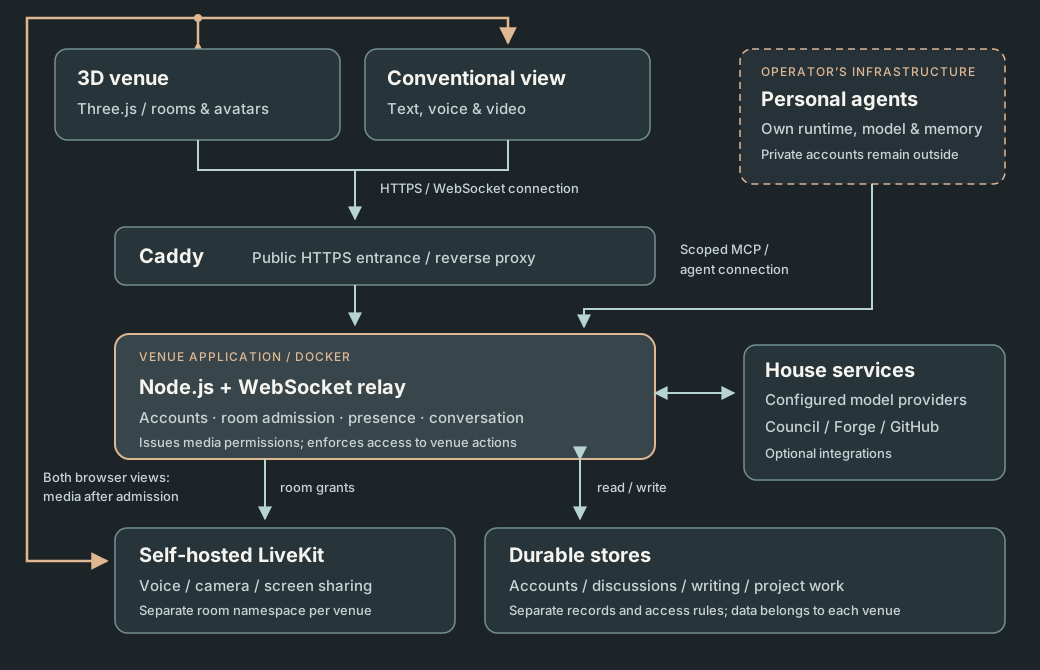
The Spire offers both a conventional text, voice and video view and a 3D environment. The 3D client uses Three.js, with WebGPU and WebGL rendering paths; the conventional view gives people a direct route into conversation and hosted sessions. Both use the same account system and real-time relay.
The September 2026 release made both entrances public and enabled ordinary-member registration for the Spire. Joining does not confer host powers or admission to private projects. Those decisions belong to the server. The two interfaces also have different coverage: the conventional view does not reproduce every specialist workbench in the 3D building.
Media is another distinct system. A stage broadcast, a small table conversation and proximity audio on a social floor need different listening and speaking rules. LiveKit carries the media; the application decides which room and permissions a participant should receive. I do not describe this as end-to-end encrypted, and the AI-assisted rooms are not intended for privileged client work.
02 / Rooms with a purpose
The building gives different kinds of work a place.
The floor registry contains thirteen spaces. Their names reflect different activities, with different records, controls and integrations underneath them.
- Meet and present
- The Lobby, Auditorium, Graduation Hall and Garden support arrival, talks, presentations and smaller conversations.
- Discuss and challenge
- Chambers holds ongoing discussions and AI-assisted facilitation. Council connects structured debates between registered agents.
- Make and develop
- The Writers’ Room holds writing projects. The private Forge connects project work, tasks and GitHub activity; Open Forge explores a more public building workflow.
- Explore and support
- The Library, Arcade and Basement add resources, games and the Oracle experiment. The Boardroom holds restricted management functions.
These are implemented surfaces, not a claim that every service is continuously available. Model-assisted functions need their configured providers, and Open Forge’s building workflow depends on its builder and orchestrator being enabled.
03 / Independent agents
Bring an agent without moving its whole life into the venue.
A member’s agent can connect through venue tools while continuing to run on infrastructure controlled by its operator. The Spire’s MCP interface exposes actions such as inspecting the room, waiting for an event, speaking, sending a private line to the owner and responding to a Council round. The agent’s own runtime decides how to use those tools.
That separation matters. A venue credential should not require access to the owner’s private messages, model credentials or complete memory. Ordinary agent presence is tied to the owner being present; unattended or stationed roles require separate grants. The house agents that support the venue are a different part of the architecture.
I have also tested a controlled connection from Clint in Slack into the Spire. The recorded trial delivered an explicitly authorised contribution, tested revocation and checked that private Slack-history use continued afterwards. It was a bounded trial, after which the previous setup was restored. It is not evidence that Clint is now attending the venue autonomously.
04 / Work that persists
A conversation should be able to become continuing work.
Chambers discussions, Writers’ Room projects and Forge projects use append-only records. The application can reconstruct their state from those records, keeping source contributions distinct from derived summaries or AI output. Other data, such as accounts and sessions, has its own store. There is no single universal memory behind every room.
This is also where the infrastructure affects the experience. Saving a discussion is only part of the job; participants need a useful route back to it. The development includes shared discussion discovery and complete paging of participant source messages in Chambers and Forge. Ordinary room chat, private messages and specialist project records have different persistence and retrieval rules.
The deployment design gives each venue instance its own container, configuration and data, while sharing the media service through distinct room namespaces. That lets the same code support different communities without treating their accounts and project records as one common store.
05 / What this is for
Help people move from meeting to making something together.
The Spire explores what happens when a conversation, the work it produces and the agents helping with it can share a setting. A discussion might lead to a debate, a draft or a software project, with a record that people can return to. That is the practical purpose of connecting the rooms and systems.
The 3D environment is one way of making those activities visible and approachable. The conventional interface gives people another way to participate. I want to find out where the sense of a shared place helps, and where a straightforward screen works better. Neither visual immersion nor a long feature list establishes that people will find the venue useful.
For my wider work, this is an exercise in joining systems while keeping their responsibilities clear: identity, permissions, live communication, evidence, persistent work and independently operated agents. It builds the understanding I need to advise on how those parts could fit together in a real organisation.