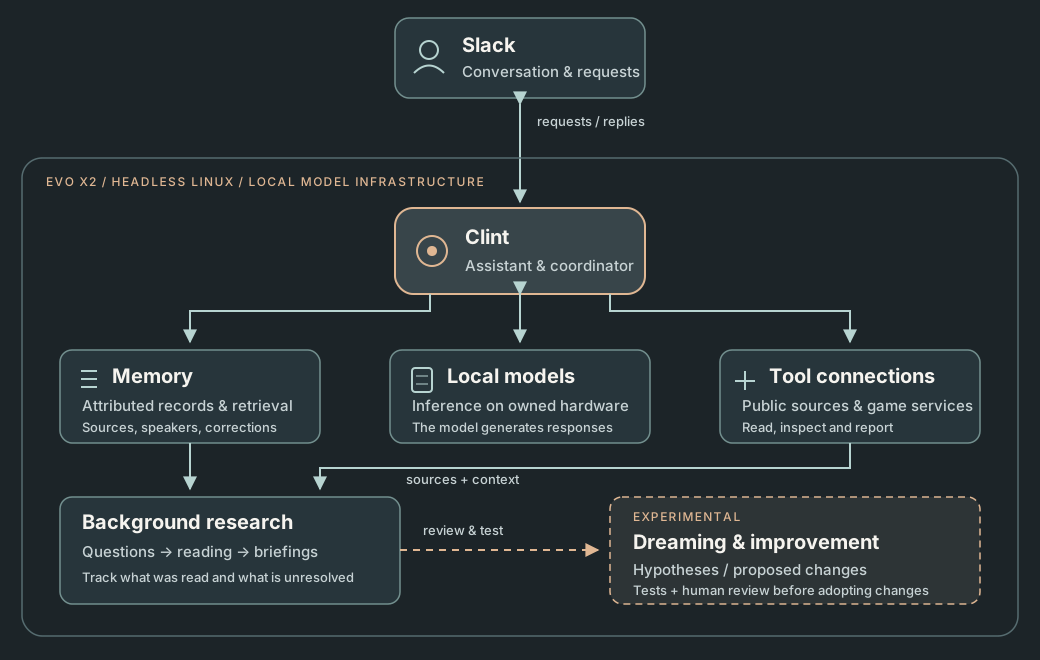
I deployed Clint in LegalQuants WhatsApp groups, where he interacted with other participants and their agents. He now lives in Slack, working as my personal assistant and helping administer my games. His development brings together much of what I have been learning about local models, memory, research, software architecture and the practical limits of autonomous agents.
Behind this work is an EVO X2 with 128 GB of unified memory, running Linux as a headless AI server in my home. It provides the local model infrastructure for a team of custom agents I have built. That is where the earlier experiments with a Raspberry Pi and document retrieval have led: to running a system that has ongoing work to do and that I have to maintain, investigate and improve.
01 / In use
From group participant to working assistant
The WhatsApp deployment put Clint into conversations with people other than me, including exchanges involving their agents. A group presents a much richer problem than a private exchange: several speakers, different intentions, overlapping conversations and statements that may be jokes, corrections or instructions. It raises questions about when an agent should contribute, whose request it is answering and what it should retain afterwards.
His current home is Slack. Alongside personal assistance and research, I use him to help keep track of the games I have built. The game tools include reading activity figures, counting current sessions where that information exists, and checking whether services respond. These are concrete tasks with answers that can be checked against the underlying systems.
Even that apparently simple work needs care. A missing activity figure must not be reported as zero. A service that answers a request has not necessarily established that everything is healthy. Reading a game's status is also a different permission from changing its settings or taking action against a player. Building these connections has made me examine exactly what each tool establishes and what authority the agent needs.
02 / Research
Research without a prompt for every step
I want Clint to do useful work between conversations. I have built background workflows that select questions from recent context, search and read public sources, and prepare research reports and briefings. The work includes scheduled technical research and self-review. The ambition is for him to notice an unfinished question, investigate it and bring back something worth my attention without needing me to specify every step.
The difficult part is establishing what happened during that investigation. Finding a search result, reading the source and supporting a conclusion are three separate things. The research workflow records what was actually read and keeps unresolved questions visible. I have also revised approaches that produced fluent reports without enough grounding. The standard I am working towards is research I can follow back to its sources and decide whether to rely on.
03 / Memory & dreaming
Memory and “dreaming”
A continuing assistant needs to remember enough to avoid starting again each time. But retaining everything creates its own problems: old instructions, superseded plans, other people's views and the agent's own mistakes can all return as apparently useful context. I have spent considerable time on attribution, retrieval and correction: who said something, when they said it, what it related to and whether it still applies.
“Dreaming” is my shorthand for reviewing earlier material in the background. The mechanism looks for patterns, conflicting statements and unresolved questions across attributed records. A proposed connection must point back to the material that prompted it and include a question through which it could be checked. It remains a hypothesis. Two accounts giving different dates, for example, should produce a question about which source governs, rather than an invented resolution.
The attraction is that an agent might find a useful connection I have not explicitly asked it to look for. The challenge is preventing its own interpretation from quietly becoming a fact in its memory. That distinction has become central to how I think about persistent agents.
04 / Self-improvement
Improving the agent itself
I am exploring how Clint can examine failures and help improve the system around him. This includes mechanisms for proposing code changes, running an existing version and a candidate through tests in an isolated environment, and returning the results for review. A proposal has to earn its place through evidence; generating a patch does not give it permission to deploy itself.
There is a separate question about learning from feedback. Some teaching experiments successfully stored a correction but failed when it had to be applied to a new problem. In one test, details from an illustrative example appeared in an unrelated answer. In another, the system invented facts to support a recommendation. The storage mechanism worked; the intended learning did not. Those results led me to set aside the failed approach.
This is where much of the development effort goes: working out whether a change has improved behaviour, whether the improvement transfers beyond the example used to build it, and whether something else has become worse. I remain interested in self-improvement precisely because it is difficult to establish. A convincing account of what the agent has learned is not sufficient evidence that it has learned it.
05 / Engineering
Making the parts work together
Running the system at home makes the engineering tangible. Local inference, retrieval, memory and background jobs compete for finite resources. Research has to yield when I need a response. Work needs a recorded state so that an interruption does not become a silently abandoned task. Connections to outside services need clear permissions, and an agent participating in a group must not acquire access to my private tools simply because I am also in that group.
These are the plumbing and wiring I want to understand. Changing a model or adding a tool affects the rest of the system, so I spend time tracing those relationships and testing the consequences. Clint is in use, but remains under active development; the more ambitious research, reflection and improvement mechanisms are continuing experiments.
06 / What this is for
What this is for
The immediate aim is an assistant that reduces the work of keeping track: carrying useful context forward, following up questions, helping me run my projects and bringing back research I can inspect. Success would mean needing less supervision for a defined task while still being able to understand what he did and intervene when necessary.
The wider purpose connects directly to my work with clients. Building and running Clint gives me specific questions to ask about an agent's memory, evidence, permissions and claimed autonomy. It helps me explain to a lawyer or a senior decision-maker what a system is doing, where it could help and what still needs engineering or human judgment. That is the position I want to occupy between technical development and experienced legal practice.
It also informs the education and access-to-justice work I want to do. Useful assistance should help people understand a problem and take the next step while preserving their ability to question the answer and make their own decisions. Clint is one way I am learning what it takes to build that kind of assistance, and where today's systems still fall short.